Business calling and VoIP support
Business calling that fits your operation.
A caller should not need to understand your staffing arrangement to reach the right place.
SignalHarbor IT helps Maryland businesses organize their calling setup around the people answering, the locations involved, and what should happen when someone is unavailable. We connect those requirements to the supported phone service, equipment, and ongoing administration.
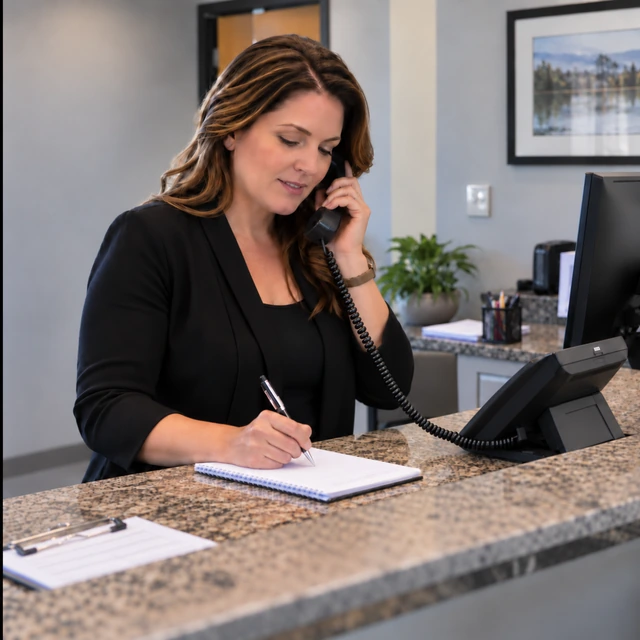
Follow a call through the business.
What happens when the main number rings? Who answers during a busy period? Where does the call go after hours? How is a message picked up and acted on?
The answers define how the calling service needs to work before individual features are selected.
Put the everyday calling decisions in order.
Users and numbers
Identify which people, shared roles, and locations need a number or extension—and who manages changes.
Call handling
Define the intended greetings, routing, and unanswered-call behavior. Available functions must match the selected platform and service.
Phones and working locations
Consider how people will place and receive calls. Desk-phone or application-based use depends on supported devices, subscriptions, and connectivity.
Ongoing administration
Keep agreed settings and user changes connected to a support route, with provider responsibilities made clear.
The calling service is only part of the setup.
INCLUDED ADMINISTRATION AND SUPPORT
The users, configuration work, troubleshooting, and routine changes covered by the agreement.
PROVIDER-CONTROLLED WORK
Number availability, transfers, carrier service, emergency-calling arrangements, and other provider dependencies.
SEPARATELY SCOPED ITEMS
Equipment, deployment, network changes, additional features, and integrations outside the agreed service.
The proposal identifies the features supported by the selected service and any separately charged options.
Plan the change before moving the number.
We discuss the current setup, essential numbers, calling patterns, equipment, and any dependencies on existing lines.
The transition needs to account for provider requirements, configuration, testing, and the point at which the new arrangement can be relied on. Existing service should not be canceled on the assumption that a number transfer has already completed.
Include connectivity and emergency calling in the discussion.
A hosted platform does not remove local power, network, or location-information dependencies. The selected service and device arrangement need a clear explanation of what happens during an interruption and how emergency calling is configured.
An alternative calling route is useful only when it is actually supported, configured, and understood.
Understand the recurring and one-time costs.
Compare the calling subscription, numbers or users, equipment, deployment, ongoing support, and any separately charged features. A lower headline rate does not explain the complete arrangement.
Frequently asked questions
Can we keep our existing telephone numbers?
We check number eligibility, account information, authorization, and transfer requirements with the providers involved. Keep the existing service in place until the transfer is confirmed. A transfer date is not guaranteed before those checks are complete.
Can staff use desk phones and mobile or desktop applications?
The supported options depend on the chosen service, devices, and subscriptions. The useful starting point is how each person works: at a fixed desk, across locations, or away from the office. We discuss that need before presenting a particular application or handset as part of the service.
What happens if the internet or power fails?
Some functions may become unavailable, depending on the equipment and connectivity affected. Alternate routing, backup connectivity, or other arrangements depend on the selected platform and configuration. They should not be assumed from the fact that the phone service is cloud-based. The plan needs to identify what remains usable and what does not.
How is emergency calling handled?
Emergency calling depends on the provider, device, configuration, and relevant location information. Responsibilities for activation, address maintenance, user guidance, and changes in location must be clear. Do not assume that a mobile application or relocated phone automatically reports its current position in the same way as another telephone service.
Can we connect fax machines, door intercoms, alarms, or other equipment?
Those uses need to be assessed individually. An ordinary voice-calling service is not proof of compatibility with an existing device or specialist line. Identify these dependencies before changing providers or canceling service, so the appropriate equipment, provider, or specialist can be involved.
Make the next call easier to handle.
Tell us how callers reach the business today—and where that process breaks down. We will use it to discuss the right calling setup.