Cybersecurity for Maryland businesses
Cybersecurity across the way you work.
Accounts, computers, email, shared files, and network connections do not operate in isolation. Neither should their protection.
SignalHarbor IT helps connect relevant safeguards to everyday IT management. We start with how your environment is used, where important information lives, and who is responsible for the decisions and work that follow.
A stronger, more secure foundation
Consider the safeguards together.
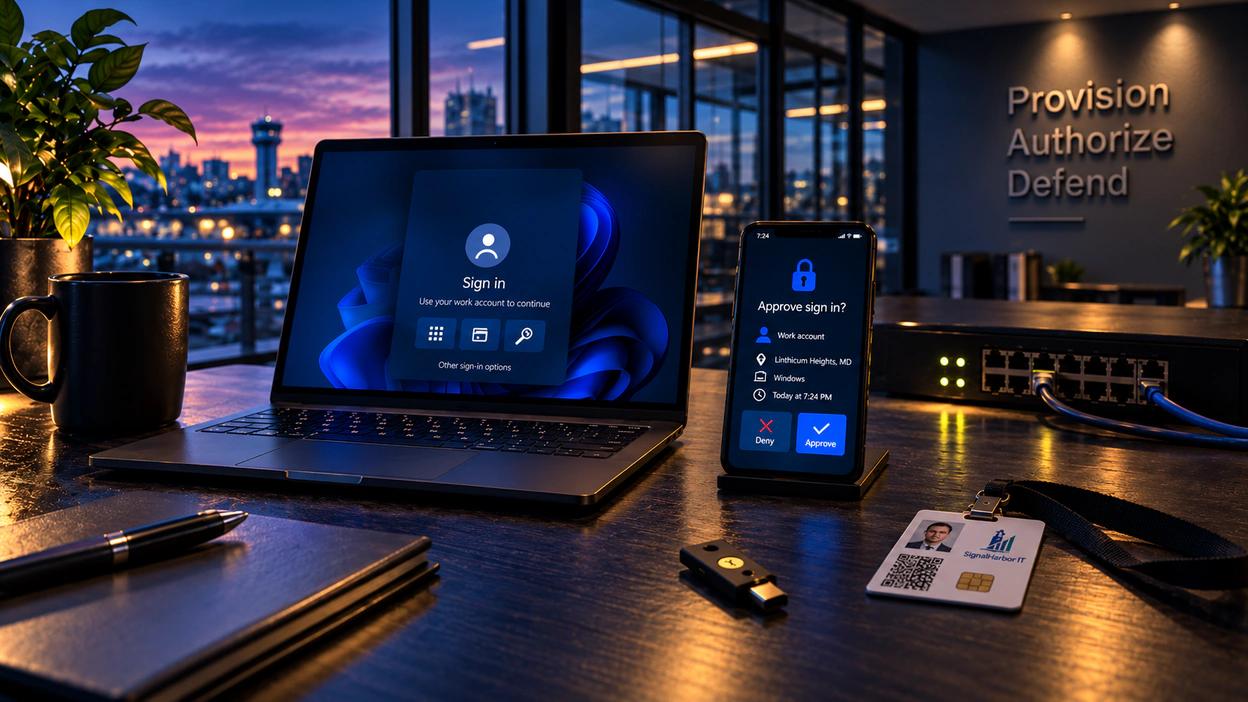
Security works best when every layer is considered as part of the same picture. People, devices, and data are connected, and each relies on the others. A coordinated approach helps reduce risk and gives you a clearer, more effective security posture.
Identity and access
Make sure the right people have the right access, with strong authentication and ongoing review.
Devices and maintenance
Keep devices secure, updated, and properly configured to reduce opportunities for attack.
Email, cloud, and connections
Help protect against phishing and other threats across email, cloud services, and your wider network.
Priorities and responsibility
We turn identified risks into clear next steps, and clarify what SignalHarbor manages, what the business decides, and what another provider must address.
Make the important decisions visible.
A former employee’s access has not been reviewed. An administrator account is used for ordinary work. A shared folder has more access than its owner intended.
Each situation needs a clear next step: establish the current access, agree what should change, and identify who can approve it.
A product is not the same as an operating arrangement.
Protection tools, alerting, investigation, and response are different responsibilities.
Your service scope should identify the safeguards included, who receives and handles relevant alerts, what action is authorized, and how matters are escalated. It should also explain any dependence on an external security provider.
Specialist investigations, extensive remediation, and incident-response engagements require their own agreed scope.
Improve the environment in a workable order.
We begin with the agreed review scope and the systems involved. From there, we help distinguish immediate concerns from planned improvements, discuss the impact of changes, and assign responsibility for the work.
The result should be a set of priorities your organization can act on and maintain alongside everyday IT support.
Understand what the security service covers.
Compare the controls, covered systems, operator responsibilities, availability, and escalation arrangements—not just product names. Licenses, additional services, and separately scoped work should be distinguishable.
Frequently asked questions
Where do we start if we do not know what is missing?
Start with the concern and a broad picture of the environment. An IT review helps establish what needs closer examination and what information is required. A discussion of your priorities is not automatically a vulnerability scan, penetration test, or compliance audit. Any technical assessment needs its own defined scope and authorization.
Is antivirus or multifactor authentication enough?
Each addresses particular risks; neither settles every question about access, devices, information, and recovery. The useful next step is to consider the controls together and understand what remains outside their coverage. The aim is not to accumulate products, but to establish appropriate safeguards and the responsibilities needed to maintain them.
How are monitoring and response responsibilities defined?
The agreement needs to identify what is monitored, who handles relevant alerts, the hours covered, and the actions that can be taken. Automated activity is not the same as continuous human investigation. Where another provider is involved, its role and the escalation path should be clear before an incident occurs.
Will these services make us compliant?
Technical safeguards can support particular obligations, but an IT service alone does not establish compliance or certification. Policies, business practices, contracts, records, and assessment requirements may also matter. Relevant obligations must be identified, and any compliance-related work needs precise scope rather than a blanket promise on a service page.
What remains our organization’s responsibility?
Your organization decides who should have access, approves relevant changes, communicates staff and operational changes, and maintains the business practices outside the IT service. Employees also need a usable way to raise concerns. Those responsibilities should be discussed alongside the technical work rather than left implicit.
Make the next security decision a clearer one.
Bring the unanswered question: access, devices, information, or what would happen next. We will start by establishing what needs attention.